Loompaland
Charlie and the Chocolate FactoryLoompaland is presented as the remote homeland of the Oompa-Loompas, a place defined by perilous jungle conditions, scarce food, and an intense longing for cacao beans. Its decisive significance lies in the fact that the hidden workforce of Wonka's factory does not originate there by accident: Willy Wonka discovers the tribe's hunger for the raw material of chocolate, offers cacao beans and chocolate in exchange for factory work, and transports every member of the tribe to his industrial world. Loompaland therefore stands behind the factory's apparent magic as both a literal place and the source of a complicated labor arrangement.
A Remote and Dangerous Homeland
Loompaland enters the story through Willy Wonka's explanation that the tiny workers are Oompa-Loompas imported directly from that country. When Mrs Salt disputes its existence, Wonka describes it as a terrible land of thick jungles filled with dangerous beasts: hornswogglers, snozzwangers, and especially whangdoodles, which he says could eat ten Oompa-Loompas for breakfast and return for more. The Oompa-Loompas therefore live under continuous environmental and bodily threat rather than in a landscape of easy abundance.
Their defensive way of life reflects that danger. Wonka says that they live in tree houses because the jungle animals make the ground unsafe. Their environment also restricts what they can eat. They survive on green caterpillars, whose taste is revolting, and spend their days searching through the treetops for red beetles, eucalyptus leaves, or bark from the bong-bong tree to mix with them. The details make Loompaland a place where food is not simply enjoyed but painfully improvised from whatever the inhabitants can find.
Cacao and the Oompa-Loompas' Desire
Against this background of scarcity, cacao beans become the one food the Oompa-Loompas desire above all others. Wonka says that an Oompa-Loompa is fortunate to find even three or four cacao beans in a year, although cacao is the essential ingredient from which chocolate is made. Their craving is described as constant: they dream about cacao beans at night, talk about them during the day, and react physically when the word cacao is mentioned.
This hunger connects Loompaland directly to the economics of Wonka's factory. Chocolate is not merely a finished sweet produced by machines; it depends on a scarce agricultural resource that the Oompa-Loompas cannot obtain in their homeland but that Wonka possesses in enormous quantities. By presenting cacao as both food and payment, Wonka turns the tribe's deepest deprivation into the basis of recruitment. The arrangement appears generous because it promises relief from hunger, yet it also reveals how completely their labor is tied to control over the commodity they most want.
Relocation to Wonka's Factory
Wonka recalls approaching the tree house of the Oompa-Loompa leader and offering the entire tribe all the cacao beans they could want. He promises mountains of beans in his storehouses, cacao with every meal, and even wages paid in cacao if that is what they prefer. He adds that chocolate would be better still because milk and sugar are mixed with the beans. The leader accepts immediately, throwing his bowl of mashed caterpillars out of the tree-house window and declaring the arrangement a deal.
Wonka then says that he shipped every man, woman, and child in the Oompa-Loompa tribe to his country. The transport is described as smuggling them in large packing cases with holes in them, although Wonka assures the visitors that everyone arrived safely. The scale of the movement matters: this is not the recruitment of a few specialists but the removal of an entire population from Loompaland and its installation inside a private factory.
Once relocated, the Oompa-Loompas become the factory's concealed labor force. Grandpa Joe has already explained that Wonka dismissed all his former workers because rival chocolate makers sent spies to steal his recipes, then closed the gates and stopped all visible production. When the factory later resumes its work, no ordinary workers are seen returning. Instead, chocolates and sweets emerge through a special trap door and are collected by Post Office trucks, while tiny shadows appear behind the windows. The Loompalands' inhabitants thus help explain how production continues while the factory remains inaccessible and its owner unseen.
Work, Culture, and Representation
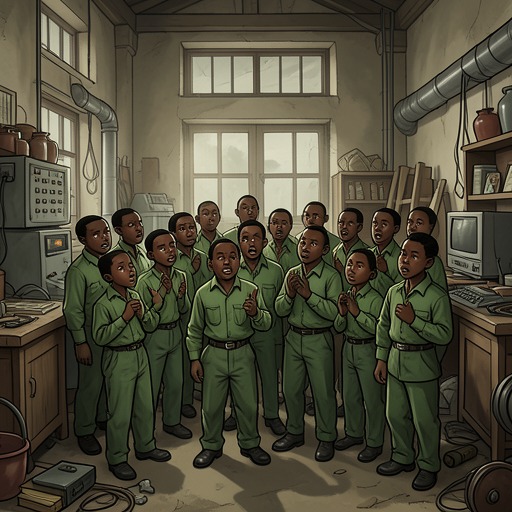
Wonka praises the Oompa-Loompas as wonderful workers and says that they all speak English after arriving at the factory. He also emphasizes their love of dancing, music, and song, their mischievousness, and their fondness for jokes. Their presence combines industrial usefulness with theatrical entertainment: they produce the goods that sustain Wonka's business, but they also become part of the factory's spectacle and its musical discipline.
Their clothing remains, according to Wonka, the clothing they wore in the jungle. The men wear deerskins, the women wear leaves, and the children wear nothing, with the women using fresh leaves each day. This description preserves Loompaland as an exoticized image within the factory, even after the tribe has been removed from it. The homeland is consequently represented through danger, appetite, costume, and spectacle rather than through an independent account from the Oompa-Loompa people themselves. Their leader speaks during Wonka's recollection, but the history of the tribe is chiefly narrated and interpreted by Wonka.
The contrast between Loompaland and the factory is also a contrast between scarcity and controlled abundance. In Loompaland, cacao beans are nearly unobtainable and caterpillars are everyday food; in Wonka's storehouses, cacao exists in mountains and can be distributed as meals or wages. The factory appears to rescue the tribe from hunger, but the same contrast makes their dependence on Wonka unmistakable. Access to food, employment, and the conditions of their new life all pass through his authority.
Narrative Significance
Loompaland expands the mystery of Wonka's factory beyond locked gates and secret recipes. The factory is not self-sufficient: its wonders rely on a distant homeland, on cacao cultivation, and on a displaced community whose labor is hidden from the public. That global connection stands in sharp contrast to the worldwide frenzy surrounding the Golden Tickets, in which adults and children buy huge quantities of Wonka bars across many countries while the people who make the production possible remain largely invisible.
The place also sharpens the book's recurring contrast between hunger and excess. Charlie Bucket's family can afford only bread and margarine, boiled potatoes and cabbage, and cabbage soup; Charlie longs above all for chocolate and receives only one small bar on his birthday. In the factory, by contrast, the Chocolate River contains enough hot melted chocolate to fill every bathtub and swimming pool in the country, while Augustus Gloop kneels at its edge and scoops the chocolate into his mouth. Loompaland belongs to the other side of that contrast: it is the imagined origin of deprivation that makes Wonka's abundance appear miraculous.
Finally, Loompaland provides the moral and structural foundation for the Oompa-Loompas' role. Their relocation explains the factory's secret workforce, their craving explains why they accept Wonka's offer, and their songs and jokes help transform industrial labor into a pageant. The homeland is therefore absent from the tour as a physical destination but ever-present in the factory's social order: every apparently magical product carries the memory of a place where cacao was scarce and of a people whose access to it was made conditional on serving Wonka's enterprise.